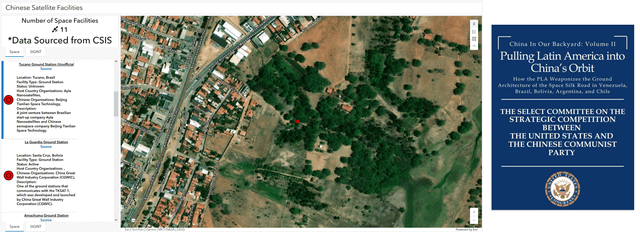
Unveiling Allegations: A US Report Points to a "Secret Chinese Base" in Brazil
In a development that has sent ripples through geopolitical circles, a recent report from the United States Congress has ignited intense debate and speculation. The document alleges the existence of a “secret Chinese base” in Brazil, specifically pinpointing an installation in Salvador, Bahia, described as the “Tucano Ground Station.” This revelation, part of a broader examination of Beijing’s expanding influence in Latin America, raises critical questions about regional security, international partnerships, and the delicate balance of power. While the term base secreta china brasil immediately conjures images of covert military operations, the reality, as outlined in the report, is more nuanced, yet equally concerning for US interests.
The report, titled “Attracting Latin America into China's Orbit,” was published by the US House of Representatives' Select Committee on the Chinese Communist Party. It frames these alleged initiatives as part of a systematic effort by Beijing to deepen its diplomatic, economic, technological, and potentially military footprint across the continent. For many, this isn't just about a single location; it's about understanding the long-term strategic implications of China's growing presence in a region traditionally considered within the US sphere of influence.
The Tucano Ground Station: At the Heart of the Allegations
According to the US Congressional report, the alleged Chinese installation, dubbed the “Tucano Ground Station,” is not a traditional, officially recognized military base. Instead, it is described as an “unofficial” facility operating within the premises of Ayla Space, a Brazilian aerospace company located in Salvador, Bahia. The report claims this station is a product of a partnership between Ayla Space and Beijing Tianlian Space Technology, a Chinese entity. Its purported function is what has particularly drawn the ire and concern of US lawmakers.
The document suggests that the Tucano Ground Station provides the People's Republic of China (PRC) with a significant capability: the ability to identify foreign military assets and track space objects in real-time across the South American continent. This intelligence-gathering capacity, if true, could offer Beijing an unprecedented strategic advantage, allowing it to monitor activities vital to the national security interests of the United States and its allies. The report explicitly states, “[The base] provides the RPC [People's Republic of China] a channel to observe and influence Brazilian military space doctrine, while establishing a permanent presence in a region vital to U.S. national security.” This highlights the dual concern: not only the direct intelligence implications but also the potential for long-term influence over Brazilian strategic thought and capabilities.
The very nature of aerospace partnerships often involves dual-use technologies, making it challenging to definitively categorize facilities as purely civilian or overtly military. However, the report’s emphasis on the strategic capabilities this alleged base da China no Brasil could provide suggests a strong military application, even if its facade is commercial or scientific. For a deeper dive into the specifics of this alleged facility, you can read more in our related article: Tucano Ground Station: Is China Building a Secret Base in Brazil?
Beyond Bahia: China's Broader Strategic Footprint in Latin America
While the Tucano Ground Station garners significant attention, the US report paints a picture of a much broader and more pervasive Chinese strategy to integrate Latin American economies and strategic capabilities into its global framework. The alleged base secreta chinesa no Brasil in Salvador is presented as just one piece of a larger puzzle. Another initiative highlighted in the report is the “China-Brazil Joint Laboratory for Radio Astronomy Technology.” Located in Serra do Uruba, Paraíba, this laboratory was established through a partnership involving China’s Electric Power Science and Technology Network Communications Research Institute, Brazil's Federal University of Campina Grande (UFCG), and the Federal University of Paraíba (UFPB). Signed in 2025, this project aims at bilateral collaboration in advanced radio astronomy research, an area with both profound scientific and potential intelligence applications.
The report details China's systematic investments across the region, focusing on:
- Infrastructure Development: Massive projects in ports, roads, railways, and energy, often funded by Chinese state-backed banks, creating significant economic ties.
- Strategic Minerals: Securing access to vital resources like lithium, copper, and iron ore, crucial for China's industrial and technological ambitions.
- Advanced Telecommunications Networks: Rolling out 5G infrastructure and other digital technologies, frequently with companies like Huawei and ZTE, raising concerns about data security and surveillance.
- Aerospace Partnerships: Collaborations in satellite technology, space launch services, and ground stations, which can have both civilian and military “dual-use” potential.
These initiatives, according to the US Congressional committee, are not isolated ventures but components of a cohesive strategy to “attract Latin America into China's orbit.” This multi-faceted approach aims to expand Beijing's diplomatic, economic, technological, and potentially military influence, shifting regional allegiances and challenging established power dynamics. The cumulative effect of these partnerships could grant China substantial leverage and access across the continent, fundamentally altering the geopolitical landscape.
Geopolitical Ramifications and the Challenge to Sovereignty
The allegations surrounding the base secreta china brasil carry significant geopolitical weight. For the United States, the establishment of such a facility — even an “unofficial” one — in its historical “backyard” represents a direct challenge to its national security interests and regional hegemony. The capability to track US military assets from a close distance in South America would undoubtedly force a reassessment of US defense strategies and intelligence operations in the region. This is a clear indicator of the growing competition between global powers, extending into new frontiers like space and cyberspace.
For Brazil, the situation is delicate. While closer ties with China offer considerable economic benefits — China being Brazil's largest trading partner — hosting installations that are perceived as military by a major global power can complicate its foreign policy and sovereignty. The Brazilian government has not yet issued an official statement confirming or denying the existence of a Chinese military base on its territory. This silence, or perhaps careful diplomatic consideration, underscores the sensitivity of the issue. Should these allegations prove true, Brazil would face the difficult task of balancing its economic relationship with China against its long-standing strategic ties with the United States and maintaining its own sovereign control over its territory.
The report's claims raise questions about transparency and accountability in international partnerships. When aerospace or scientific collaborations are suspected of having military applications, it places partner nations in a precarious position. Brazil, like many other nations engaging with China, must navigate these complex waters, ensuring that its agreements align with its national interests and do not inadvertently compromise its security or neutrality. For a deeper understanding of the broader implications, consider reading US Alarms Over China's Alleged Brazilian Base: Geopolitical Impact.
Navigating the Information Landscape: What We Know and Don't Know
It is crucial to approach these allegations with a balanced perspective, acknowledging what is stated in the US report and what remains unconfirmed. The report, while comprehensive in its scope, represents the perspective and concerns of a specific US Congressional committee. It is an intelligence assessment, not a definitive, publicly corroborated fact by all involved parties.
Key takeaways:
- Allegations vs. Confirmation: The existence of a “secret military base” as defined by the US report remains an allegation. Brazilian authorities have not publicly confirmed or denied the military nature of the Tucano Ground Station.
- Dual-Use Technology: Many technologies, especially in aerospace and radio astronomy, have both civilian research and potential military applications. Distinguishing between them can be complex and is often a point of contention in intelligence assessments.
- Transparency is Key: In an era of heightened geopolitical competition, transparency from all nations involved in such partnerships becomes paramount. Clear communication regarding the purpose and activities of joint ventures can help mitigate suspicion and foster trust.
- The Broader Context: Regardless of the exact military nature of the alleged base secreta china brasil, the report undeniably highlights China's expanding influence across Latin America, which is a significant geopolitical trend that demands attention.
As this story develops, it will be essential to observe official responses from both the Brazilian and Chinese governments, as well as any further evidence or clarifications that may emerge. The interplay between economic opportunity, scientific collaboration, and strategic security will continue to define this complex relationship.
Conclusion
The US Congressional report alleging a “secret Chinese base” in Brazil — specifically the Tucano Ground Station in Salvador, Bahia — underscores the intensifying geopolitical competition between global powers. While the term base secreta china brasil has sparked immediate alarm, the allegations point to a more nuanced reality of aerospace partnerships with potential dual-use capabilities, alongside China's broader strategy of expanding its diplomatic, economic, technological, and military influence across Latin America. As nations navigate complex international relations, the need for transparency, clear communication, and a balanced understanding of strategic intentions will be critical to maintaining regional stability and safeguarding national sovereignty. The unfolding narrative surrounding these allegations will undoubtedly shape future discussions on international cooperation, national security, and the evolving global balance of power.